

Simple Network Management Protocol (SNMP) is one of the most widely used protocols for monitoring and managing network devices. Yet, in my experience, it is also one of the most misunderstood. I’ve seen SNMP configured once, left running in the background, and only revisited when alerts start flooding in or visibility suddenly drops.
I wrote this guide to clearly explain what SNMP is, why it exists, and how it actually works in real-world network environments. The goal here is not to dive into protocol-heavy theory, but to break SNMP down into practical concepts that make sense whether you manage a small network or a large enterprise infrastructure. I focus on where SNMP fits in modern network management, the problems it helps solve, and why it continues to remain relevant today. If you’re looking for a clear, no-nonsense understanding of SNMP, this article is meant to give you exactly that.
What Is Simple Network Management Protocol (SNMP)?
Simple Network Management Protocol (SNMP) is a network protocol that enables monitoring systems to collect operational data from network-connected devices. In practice, I’ve used it to query devices for metrics such as availability, performance, and resource usage, and to receive alerts when predefined conditions are met in production environments.
SNMP uses a standardized communication model so monitoring tools can interact with devices from different vendors in a consistent way. This consistency is what makes it possible to observe network health, identify faults, and manage infrastructure at scale without requiring direct access to individual devices.
What Is SNMP Used For?
SNMP is used to monitor the health and performance of network-connected devices from a central location. In my experience, this becomes especially valuable when managing multiple devices where logging into each one individually is not practical.
In practice, SNMP is commonly used to:
Track device availability and uptime
Monitor CPU, memory, bandwidth, and interface usage
Detect faults, outages, and abnormal behavior
Receive alerts when thresholds are crossed
Maintain visibility across large or distributed networks
SNMP is widely used in enterprise environments, data centers, ISPs, and hybrid infrastructures, where continuous visibility and early issue detection are critical. I’ve found that having consistent, real-time insight into devices makes it easier to respond faster, reduce downtime, and operate networks more reliably.
What Is Network Management?
Network management is the process of monitoring, controlling, and maintaining a network to ensure it operates reliably, securely, and efficiently. It involves keeping track of network devices, connections, performance, and failures across an entire infrastructure.
In practice, network management includes tasks such as monitoring uptime, analyzing traffic, detecting faults, applying configurations, and responding to issues before they impact users. This becomes especially important in enterprise and distributed environments where networks are complex and constantly changing.
Protocols like SNMP play a key role in network management by providing a standardized way to collect data, detect problems, and maintain visibility across diverse network devices.
How SNMP Works?
SNMP works using a simple manager–agent communication model. This is usually the point where things start to make sense once you’ve seen SNMP in action. Network devices run an SNMP agent, which collects operational data such as performance metrics and device status. A central monitoring system, known as the SNMP manager, communicates with these agents to retrieve information.
The SNMP manager periodically requests data from devices to understand their current state. In addition to these requests, devices can also send alerts, called traps, when specific events occur, such as failures or threshold breaches.
This combination of regular data collection and event-based alerts allows teams to monitor network health in near real time. By using standardized data structures, SNMP ensures consistent monitoring across devices from different vendors without requiring direct access to each device.
SNMP Architecture
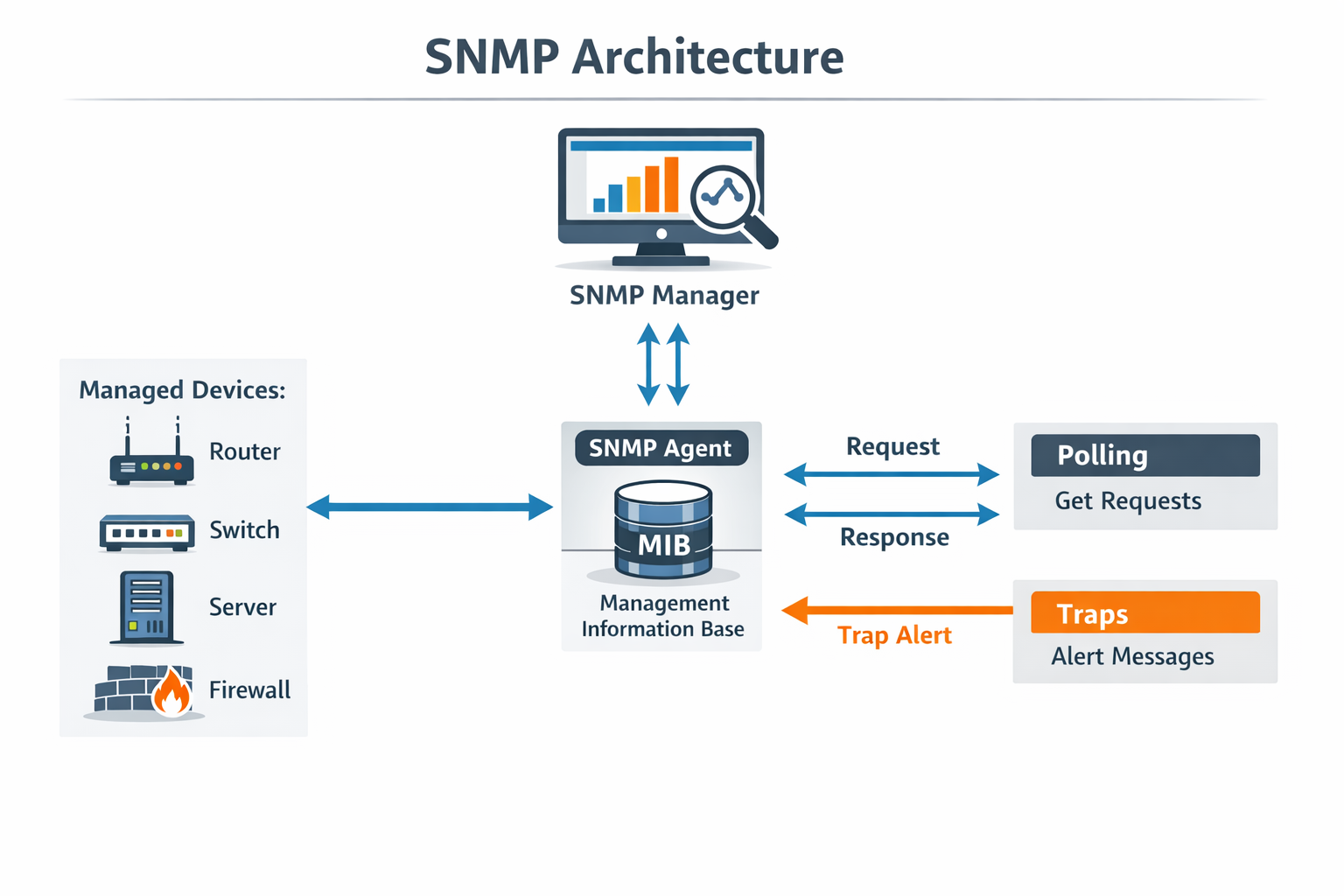
SNMP follows a simple and scalable architecture built around a manager–agent model. I’ve found this simplicity to be one of the main reasons SNMP scales well across both small and enterprise networks. At the center of this architecture is the SNMP manager, which acts as the control point for monitoring and managing the network.
Each network device runs an SNMP agent that collects local data and exposes it in a structured format. The manager communicates with these agents to retrieve metrics, apply configurations, or receive event notifications. All device data is organized using standardized definitions, allowing consistent communication across different hardware and vendors.
This architecture supports both polling-based monitoring and event-driven alerts, making it suitable for small networks as well as large enterprise environments. By separating data collection from centralized analysis, SNMP architecture enables efficient, scalable network monitoring without placing heavy overhead on network devices, something that becomes important as networks grow.
Key Components of SNMP
SNMP is built around a small set of core components that work together to enable centralized network monitoring and management. Understanding these components is usually where SNMP starts to feel less abstract.
At a high level, SNMP consists of a central monitoring system, software agents running on network devices, and a standardized data model used to expose device information. This separation allows monitoring tools to collect data consistently across devices from different vendors.
The key components of SNMP include:
SNMP Manager, which initiates requests and processes data
SNMP Agent, which runs on network devices and exposes metrics
SNMP-managed network nodes, such as routers, switches, and servers
Management Information Base (MIB), which defines how device data is structured and accessed
Together, these components form the foundation of SNMP-based monitoring, enabling visibility, alerting, and control across modern network infrastructures.
SNMP Manager
The SNMP manager is the central system that monitors and manages network devices. In real-world setups I’ve worked with, this is typically the network monitoring software teams rely on daily for visibility and alerts. It requests data from devices, processes responses, and displays network health through dashboards and alerts.
It also receives notifications, called traps, when devices report issues or significant events. By acting as a single control point, the SNMP manager helps teams maintain visibility and respond quickly to network problems.
SNMP Agent
The SNMP agent is a software component that runs on a network device and collects information about its status and performance. I usually think of the agent as the bridge between the device and the monitoring system.
The agent responds to requests from the SNMP manager and can also send alerts, known as traps, when specific events or issues occur. By exposing device data in a standardized format, the SNMP agent enables reliable monitoring across different vendors and device types.
SNMP-Managed Network Nodes
SNMP-managed network nodes are the devices being monitored and managed through SNMP. In practice, these are the systems teams care most about keeping healthy and available.
Each node runs an SNMP agent that exposes device metrics and status information to the SNMP manager. This allows teams to monitor device health, performance, and availability without directly accessing individual systems.
SNMP-managed nodes form the foundation of SNMP-based monitoring, providing the raw data needed for visibility and issue detection across the network.
Management Information Base (MIB)
The Management Information Base (MIB) is a structured database that defines what information can be collected from an SNMP-managed device. From experience, understanding MIBs is often what separates basic SNMP usage from effective monitoring.
Each SNMP agent maintains an MIB that describes available metrics such as interface status, CPU usage, memory consumption, and error counts. By using standardized MIB definitions, SNMP ensures consistent data access across devices from different vendors.
SNMP Messages and Commands
SNMP messages and commands define how the SNMP manager and agents communicate with each other. These interactions are what drive day-to-day monitoring and alerting in real environments.
The most common SNMP messages and commands include:
Get – Retrieves a specific value from a device
GetNext – Retrieves the next value in a sequence of data
GetBulk – Retrieves large sets of data efficiently
Set – Modifies a device configuration value
Trap – Sends an alert from a device to the manager when an event occurs
Inform – Sends a confirmed alert that requires acknowledgment
Together, these commands allow continuous monitoring, configuration management, and event-driven alerts, forming the core communication mechanism of SNMP.
SNMP Security Levels
SNMP security levels define how access to device data is controlled and protected. In my experience, security is often overlooked early on and revisited only after issues arise.
SNMP supports different levels of security, ranging from basic access control to strong authentication and encryption. Earlier implementations rely on shared community strings, which provide minimal protection. More secure implementations introduce user-based authentication and encrypted communication to prevent unauthorized access and data exposure.
Choosing the appropriate SNMP security level helps ensure that monitoring data remains accurate, confidential, and protected from misuse, particularly in enterprise and regulated environments.
Characteristics of SNMP
SNMP is designed to be a simple and efficient protocol for monitoring network devices at scale. These characteristics are why I still see SNMP deployed across very different environments.
Key characteristics of SNMP include:
Lightweight communication, with minimal impact on network performance
Centralized monitoring, allowing visibility across multiple devices from one system
Vendor-neutral design, enabling support for devices from different manufacturers
Scalable architecture, capable of handling growing and distributed networks
Standardized data models, ensuring consistent data collection and interpretation
These characteristics have helped SNMP remain a reliable foundation for network monitoring over many years.
Advantages of SNMP
SNMP offers several practical benefits that make it a widely adopted protocol for network monitoring and management. Many of these advantages become obvious once SNMP is running in production.
Key advantages of SNMP include:
Wide device support, with built-in compatibility across most network hardware
Low overhead, allowing monitoring without significant performance impact
Centralized visibility, making it easier to manage large or distributed networks
Real-time alerts, enabling faster detection of faults and issues
Mature and well-established, with strong tooling and community support
These advantages make SNMP a reliable choice for maintaining network visibility and operational stability in enterprise environments.
Limitations of SNMP
While SNMP is widely used, it also has limitations that are important to understand. I’ve found that recognizing these limits early helps avoid unrealistic expectations.
Common limitations of SNMP include:
Security weaknesses in older versions, especially those using community strings
Polling-based data collection, which may miss short-lived issues
Limited context, as raw metrics often require additional analysis tools
Scalability challenges, if not properly tuned in large environments
Not designed for deep application monitoring, focusing primarily on device-level data
Because of these limitations, SNMP is often combined with other monitoring methods to provide a more complete view of network and system performance.
Why SNMP Remains Relevant in Enterprise Network Management
Despite the rise of newer monitoring technologies, SNMP continues to play a critical role in enterprise network management. Its simplicity, reliability, and broad device support make it a dependable foundation for monitoring large and complex infrastructures.
SNMP provides consistent visibility across on-premises, cloud, and hybrid environments, where organizations often manage devices from multiple vendors. It integrates easily with modern monitoring platforms and works alongside newer approaches such as telemetry and flow-based monitoring.
For enterprises that require stability, scalability, and proven operational insight, SNMP remains a practical and trusted protocol for maintaining network health and ensuring uninterrupted operations.
Conclusion
Simple Network Management Protocol (SNMP) remains a foundational part of network management because it addresses a core challenge I’ve repeatedly encountered: maintaining visibility across complex environments.
While it has limitations and is often complemented by modern monitoring approaches, SNMP continues to be widely adopted due to its simplicity, scalability, and broad device support. For organizations managing diverse and distributed infrastructure, SNMP remains a practical and trusted protocol for understanding and maintaining network health.
Frequently Asked Questions (FAQs)
What does SNMP stand for?
SNMP stands for Simple Network Management Protocol. It is used to monitor and manage network devices such as routers, switches, servers, and firewalls.
Is SNMP still used today?
Yes. SNMP is still widely used in enterprise, cloud, and hybrid environments due to its reliability, low overhead, and broad device support.
What types of devices support SNMP?
Most network-connected devices support SNMP, including routers, switches, firewalls, servers, printers, and load balancers.
What is the difference between SNMP polling and traps?
Polling involves the SNMP manager regularly requesting data from devices, while traps are alerts sent by devices when specific events or issues occur.
Is SNMP secure?
Security depends on the version used. Older versions offer limited security, while newer implementations support authentication and encryption for secure communication.
Can SNMP be used for cloud environments?
Yes. SNMP is commonly used in cloud and hybrid environments to monitor virtual machines, network appliances, and underlying infrastructure components.
Is SNMP enough for complete network monitoring?
SNMP provides strong device-level visibility but is often combined with other monitoring methods for deeper application and traffic analysis.