

Hybrid cloud environments promise flexibility, scalability, and cost efficiency. However, once workloads span on-premises infrastructure, private clouds, and multiple public cloud providers, operational visibility becomes fragmented. What appears simple in architecture diagrams often introduces hidden performance dependencies in production.
In distributed environments, traditional monitoring tools rarely provide full cross-platform insight. Performance issues may originate in cloud services, on-prem systems, or the network layer connecting them. Without unified visibility, root cause analysis becomes slow and inconsistent.
This is where hybrid cloud monitoring becomes essential. Through centralized hybrid cloud network monitoring, organizations gain end-to-end visibility across applications, infrastructure, and connectivity layers.
In this guide, we’ll explain what hybrid cloud monitoring is, how it works, and why it has become a foundational requirement for modern enterprises operating in hybrid environments.
What Is Hybrid Cloud Monitoring?
Hybrid cloud monitoring is the process of tracking performance, availability, and operational health across both on-premises infrastructure and cloud environments from a unified monitoring framework.
In hybrid architectures, workloads are distributed across local data centers, private cloud environments, and public cloud platforms. Applications frequently rely on interconnected components running in different locations. Because systems are interdependent, performance issues can originate in one environment and impact another.
This monitoring framework provides centralized visibility across the distributed ecosystem. Instead of managing isolated tools for each platform, teams use integrated hybrid infrastructure monitoring capabilities to observe:
Servers and virtual machines
Containers and cloud-native services
Network connectivity between environments
Application performance and service dependencies
Resource utilization such as CPU, memory, storage, and bandwidth
The objective is to maintain consistent, end-to-end visibility so issues can be detected early and resolved efficiently.
In modern distributed environments, unified observability ensures performance remains stable, correlated, and aligned with operational and business requirements.
How Hybrid Cloud Monitoring Works?
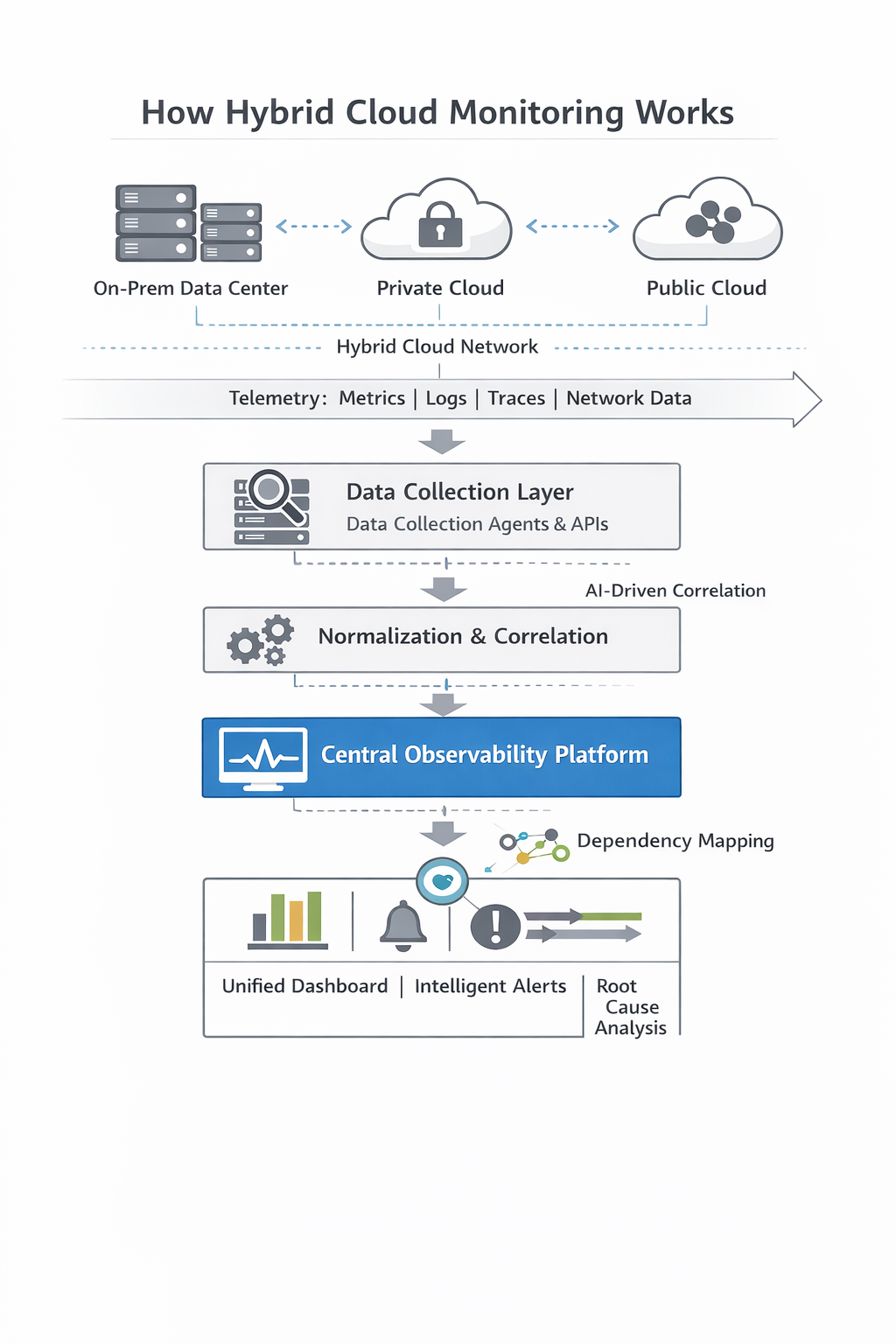
It works by continuously collecting, normalizing, and correlating performance data from distributed environments into a centralized observability platform.
In hybrid architectures, workloads operate across on-premises data centers, private cloud infrastructure, and multiple public cloud providers. Each environment generates its own telemetry, including metrics, logs, traces, and event data. Without correlation, this information remains fragmented.
The platform unifies these signals into a single operational model.
At a practical level, this involves:
Data collection agents or APIs deployed across servers, virtual machines, containers, and cloud-native services
Hybrid cloud network monitoring software to track latency, bandwidth utilization, and connectivity between on-prem and cloud environments
Application performance monitoring (APM) to trace transactions across distributed services
Centralized dashboards and intelligent alerting to visualize system health and reduce alert fatigue
The platform correlates infrastructure metrics, application behavior, and network performance to map dependencies across environments. This cross-layer visibility enables teams to trace issues end-to-end, from cloud workloads to on-prem systems and the network interconnecting them.
In distributed enterprise environments, effective hybrid cloud monitoring depends on real-time telemetry ingestion, cross-environment correlation, and context-aware alerting that highlights actionable problems rather than isolated symptoms.
Why Hybrid Cloud Monitoring Is Important
This approach is critical because distributed architectures introduce operational blind spots that traditional, single-environment tools cannot resolve.
As workloads span on-premises systems, private clouds, and public platforms, performance dependencies become interconnected. Without unified visibility, teams risk diagnosing symptoms instead of root causes.
1. Eliminates Visibility Gaps
Hybrid environments fragment data across infrastructure layers. Hybrid cloud monitoring consolidates telemetry into a single operational view, reducing blind spots and preventing siloed troubleshooting.
2. Reduces Troubleshooting Time
Modern incidents rarely stay within one environment. Unified monitoring allows teams to trace issues across infrastructure, applications, and network paths without switching between isolated tools.
3. Detects Cross-Environment Bottlenecks
Applications often depend on components running in different locations. Effective hybrid infrastructure monitoring reveals whether performance degradation originates in cloud services, on-prem systems, or the network connecting them.
4. Maintains Application Availability
Continuous monitoring identifies latency spikes, resource exhaustion, and anomaly patterns early, reducing downtime and protecting service-level objectives (SLOs).
5. Enables Proactive Capacity Planning
Instead of reacting to outages, teams can analyze trends, forecast demand, and align infrastructure scaling with business growth.
6. Strengthens Governance and Compliance
Centralized visibility across hybrid systems supports policy enforcement, audit readiness, and performance accountability across distributed environments.
In enterprise IT, unified hybrid monitoring is no longer an optional operational capability. It becomes a control layer for reliability, performance assurance, and business continuity.
Key Challenges in Hybrid Cloud Environments
Hybrid cloud environments introduce structural complexity that traditional IT operating models were not built to manage. As infrastructure spans on-premises systems, private clouds, and multiple public providers, operational visibility and control become harder to maintain.
The challenges are not isolated technical issues, they are systemic risks that affect performance, governance, and business continuity.
1. Fragmented Operational Visibility
Each environment often uses different monitoring tools, metrics, and dashboards. Without consolidation, teams lack a unified view of infrastructure health, creating blind spots across distributed systems.
2. Cross-Environment Performance Dependencies
Modern applications rarely operate within a single boundary. A database may reside on-prem, an API in the cloud, and user traffic route through edge services. When performance degrades, identifying whether the issue is infrastructure, application, or network-related becomes complex.
3. Network Latency and Connectivity Constraints
Hybrid architectures rely heavily on stable connectivity between cloud and on-prem environments. Bandwidth saturation, routing inefficiencies, or ISP peering delays can introduce unpredictable latency. Without effective hybrid cloud network monitoring, these bottlenecks often remain invisible until users are impacted.
4. Inconsistent Monitoring Standards
Public cloud providers offer native tools, while on-prem systems rely on legacy monitoring stacks. These tools measure different metrics and apply different thresholds, leading to inconsistent alerting and operational workflows.
5. Escalating Troubleshooting Complexity
When incidents occur, teams must analyze infrastructure telemetry, application traces, and network performance across multiple platforms. Without centralized correlation, root cause analysis becomes slower and more resource-intensive.
6. Expanded Security and Compliance Surface
Hybrid environments increase exposure across identity systems, access controls, and data movement paths. Maintaining consistent policy enforcement and audit readiness across distributed systems requires centralized oversight.
7. Dynamic Scaling and Capacity Uncertainty
Workloads shift between environments based on demand, cost, or resilience strategies. Predicting resource requirements and maintaining performance stability becomes significantly more complex in distributed infrastructures.
How Hybrid Cloud Monitoring Solves These Challenges
Hybrid cloud monitoring reduces operational complexity by consolidating telemetry, normalizing metrics, and correlating performance signals across distributed systems. Instead of treating environments as separate silos, it enables infrastructure to be managed as a single, observable ecosystem.
1. Establishes End-to-End Visibility
Rather than relying on fragmented dashboards, organizations gain a unified operational view across on-premises systems, private clouds, and public cloud platforms. This eliminates blind spots and restores architectural transparency.
2. Maps Cross-Environment Dependencies
Applications rarely operate within a single boundary. By correlating infrastructure metrics, application traces, and network telemetry, hybrid infrastructure monitoring enables teams to trace performance degradation across environments, from cloud workloads to on-prem databases and the network connecting them.
3. Continuously Validates Network Health
Connectivity between environments becomes measurable rather than assumed. Latency trends, bandwidth utilization, packet loss, and routing behavior are tracked in real time, ensuring bottlenecks are identified before service impact occurs.
4. Normalizes Metrics and Alerting Standards
Hybrid environments often produce inconsistent telemetry. Centralized monitoring platforms standardize thresholds, alerts, and performance baselines across environments, reducing operational noise and improving response accuracy.
5. Accelerates Root Cause Analysis
When incidents occur, correlated logs, metrics, and distributed traces provide immediate context. Instead of escalating across teams, engineers can isolate whether the issue resides in infrastructure, application logic, or network connectivity, significantly reducing mean time to resolution (MTTR).
6. Reinforces Governance and Policy Consistency
Unified monitoring supports centralized reporting, compliance validation, and performance policy enforcement across distributed infrastructure, strengthening operational control.
7. Enables Predictive Capacity Planning
Trend analysis across environments provides visibility into workload shifts and resource consumption patterns. This supports data-driven scaling decisions instead of reactive resource expansion.
When Do Organizations Need Hybrid Cloud Monitoring?
Organizations require unified hybrid monitoring once infrastructure complexity begins to exceed operational visibility.
Hybrid cloud monitoring becomes essential when:
1. Workloads Span Multiple Environments
When applications operate across on-premises systems and public cloud platforms, performance must be correlated across boundaries rather than monitored in isolation.
2. Monitoring Tools Are Fragmented
Separate dashboards for cloud, on-prem, and network layers create blind spots. Unified visibility becomes necessary to maintain operational control.
3. Root Cause Analysis Becomes Prolonged
If incidents require multiple teams to investigate independently, it signals a lack of cross-environment correlation and centralized insight.
4. Network Dependencies Impact Stability
As application performance increasingly depends on cloud-to-data-center connectivity, hybrid cloud network monitoring becomes critical to ensure consistent service delivery.
5. Governance and Compliance Requirements Expand
Distributed workloads demand centralized reporting, policy enforcement, and audit readiness across environments.
6. Cloud Adoption Accelerates
As infrastructure scales across private and public cloud providers, hybrid infrastructure monitoring becomes necessary to maintain consistency and predictability.
In short, it becomes necessary when distributed architecture introduces operational uncertainty. The moment teams begin debating whether an issue originates in the cloud, on-prem, or the network between them, unified monitoring is no longer optional.
Frequently Asked Questions
What is hybrid cloud monitoring?
Hybrid cloud monitoring is the practice of tracking performance, availability, and health across on-premises infrastructure and cloud environments through a unified monitoring platform that correlates infrastructure, network, and application data.
How is hybrid cloud monitoring different from cloud monitoring?
Cloud monitoring focuses only on workloads within a single public or private cloud platform. Hybrid cloud monitoring extends visibility across both cloud environments and on-premises systems, including the network dependencies connecting them.
Why is hybrid cloud monitoring important?
It eliminates visibility gaps in distributed architectures, accelerates root cause analysis, and ensures consistent performance across interconnected on-prem and cloud workloads.
What metrics are monitored in hybrid cloud environments?
Common metrics include CPU and memory utilization, storage performance, network latency, bandwidth usage, packet loss, application response time, service availability, and dependency mapping across environments.
When should an organization implement hybrid cloud monitoring?
Organizations should implement hybrid cloud monitoring once workloads span multiple environments and operational visibility becomes fragmented across separate tools or teams.
Can native cloud monitoring tools replace hybrid cloud monitoring?
Native cloud tools provide insight into individual platforms but typically lack cross-environment correlation. Hybrid cloud monitoring is required for unified performance analysis across distributed systems.
Conclusion
Hybrid cloud environments deliver flexibility and scalability, but they also introduce operational complexity that fragmented tools cannot effectively manage. As workloads extend across on-premises systems, private clouds, and public cloud platforms, visibility must be unified to maintain reliability and performance consistency.
This unified monitoring framework provides that control layer. By correlating infrastructure, network, and application telemetry into a single operational view, organizations gain faster diagnosis, reduced uncertainty, and stronger performance governance across distributed environments.
In modern enterprises where uptime, compliance, and user experience directly influence business outcomes, hybrid monitoring is not an enhancement, it is foundational to maintaining stability, predictability, and operational control at scale.