

Most teams don’t debate on-premise vs cloud until something breaks, slows down, or becomes too expensive. It usually starts with a simple question: Do we keep running this ourselves, or move it to the cloud?
Cloud infrastructure promises speed and flexibility. You can spin things up quickly, scale when traffic spikes, and avoid managing physical hardware. But that convenience comes with trade-offs, ongoing costs, shared responsibility for security, and less control over how systems behave under the hood.
On-premise setups, on the other hand, give teams full control and predictable performance, which is why they’re still common in regulated or performance-sensitive environments. The downside is higher upfront investment and long-term maintenance effort.
This article walks through how on-premise and cloud models actually differ in day-to-day use, and how to choose the one that fits your needs instead of following defaults.
What Is On-Premise Infrastructure?
On-premise infrastructure refers to systems that are hosted and managed within an organization’s own physical location, such as a data center or server room. The business owns the hardware, controls the software, and is responsible for setup, security, updates, and maintenance.
Because everything runs in-house, on-premise setups offer full control, predictable performance, and clearer data ownership. This is why they’re still widely used in regulated or performance-sensitive environments. The trade-off is a higher upfront cost and ongoing operational effort to manage and scale the infrastructure.
What Is Cloud Computing?
Cloud computing refers to delivering computing resources, such as servers, storage, and applications, over the internet instead of running them on local infrastructure. These resources are hosted by cloud providers and can be accessed on demand, scaled as needed, and paid for based on usage.
With cloud computing, much of the underlying infrastructure management is handled by the provider, allowing teams to focus more on applications and services. This model is widely used for its flexibility, faster deployment, and ability to scale without a large upfront investment.
On-Premise vs Cloud: Key Differences
Advantages of Cloud Computing
The biggest advantage of cloud computing is how easily it adapts to change. Capacity is no longer tied to physical hardware, which means teams can scale resources up during peak demand and scale them back when things slow down. This flexibility is hard to replicate in traditional environments.
Cloud also changes how organizations think about cost. Instead of committing large budgets upfront, teams pay for resources as they’re used. This makes it easier to test new ideas, run temporary workloads, or support growth without long procurement cycles.
Speed is another major benefit. New environments can be provisioned in minutes rather than weeks, which allows teams to release faster, experiment more freely, and respond quickly when priorities shift.
Finally, cloud platforms reduce the operational burden on internal teams. Infrastructure maintenance, patching, and upgrades are largely handled by the provider, allowing engineers to focus on applications, reliability, and business outcomes instead of hardware management.
Risks and Challenges of Cloud Computing
Cloud computing removes many infrastructure burdens, but it also introduces challenges that teams often feel only after usage grows. These risks are less about technology and more about cost control, responsibility, and long-term flexibility.
Key challenges to consider:
Unpredictable ongoing costs
Usage-based pricing can scale quickly if resources aren’t monitored closely, leading to higher-than-expected monthly bills.Shared security responsibility
Cloud providers secure the underlying infrastructure, but organizations remain responsible for data protection, access controls, and configurations. Simple misconfigurations can create serious exposure.Dependency on connectivity and provider availability
Cloud services rely on stable internet access and regional availability. Network latency, outages, or provider-side disruptions can affect performance and access.Vendor lock-in risk
Deep integration with a single provider’s services can make migration difficult or expensive later, especially for complex or long-running workloads.Reduced low-level control
Compared to on-premise environments, cloud platforms limit direct control over hardware behavior and fine-grained system tuning.
Advantages of On-Premise Infrastructure
The biggest strength of on-premise infrastructure is control. Organizations own the hardware, software, and configurations end to end, which makes it easier to design environments around specific security, performance, or operational requirements rather than provider limitations.
On-premise systems also deliver predictable performance. Because resources are dedicated and not shared with other tenants, workloads behave consistently. This matters for latency-sensitive, high-throughput, or mission-critical applications where variability isn’t acceptable.
Compliance and data residency are often easier to manage on-premise. Keeping systems within controlled facilities allows organizations to enforce strict access policies, meet regulatory obligations, and maintain clearer audit boundaries.
For stable, long-running workloads with well-understood usage patterns, on-premise infrastructure can also be cost-efficient over time. Once the initial investment is absorbed, operating costs tend to be more predictable than usage-based cloud pricing.
Risks and Limitations of On-Premise
On-premise infrastructure comes with trade-offs that become more visible as systems grow and age. While control is a major benefit, it also brings added responsibility and long-term complexity.
Key limitations to consider
High upfront investment
Hardware, licensing, data center space, and setup costs are incurred early, often before systems reach full utilization.Ongoing operational overhead
Internal teams must handle maintenance, patching, backups, hardware failures, and disaster recovery.Limited scalability
Expanding capacity requires procurement, installation, and planning, which slows response to sudden demand.Slower innovation cycles
Experimenting with new tools or architectures is harder when infrastructure changes carry real cost and risk.Resilience depends on in-house design
High availability, redundancy, and failover must be architected and maintained internally.
Hybrid Cloud: Combining On-Premise and Cloud
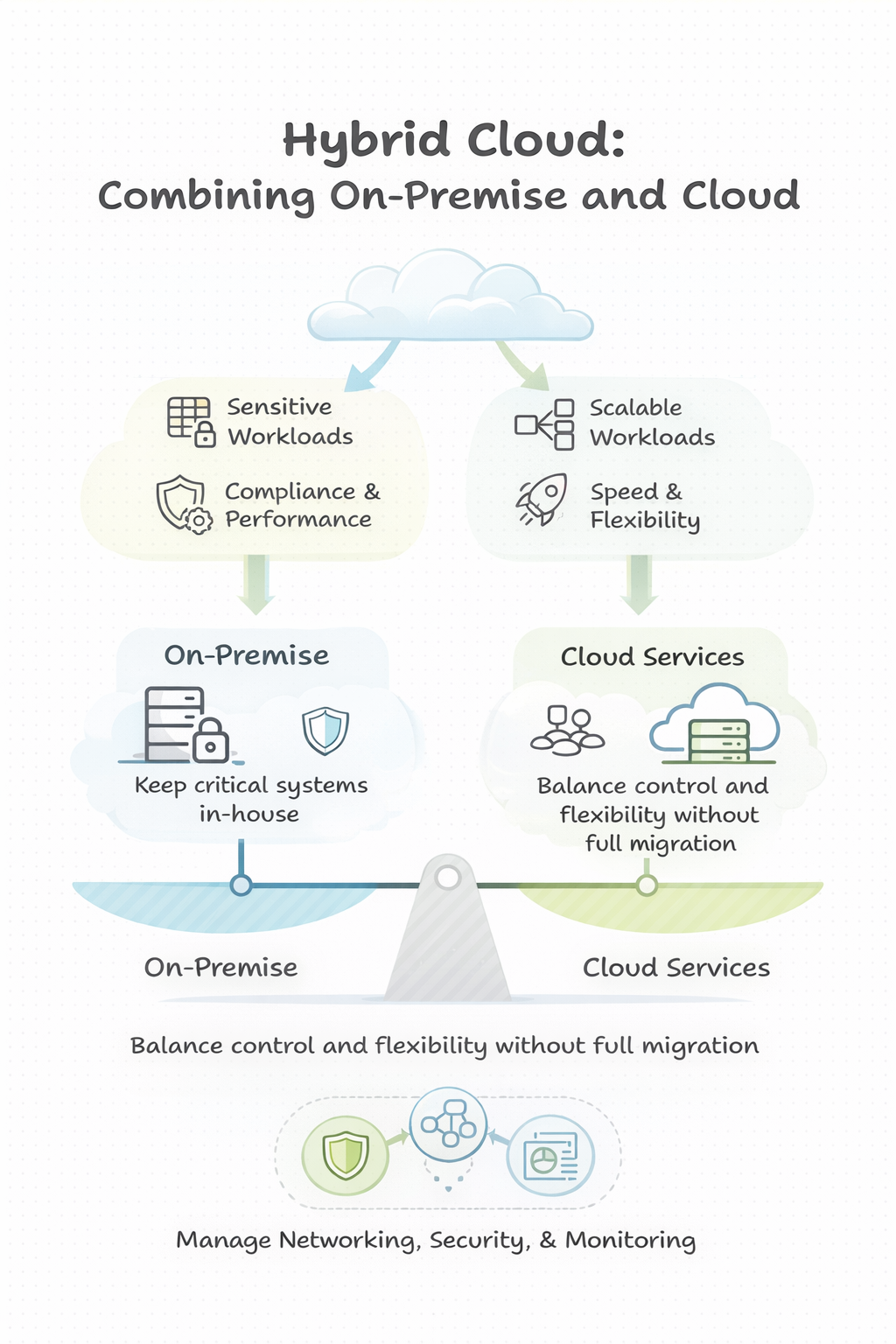
Hybrid cloud is often the result of real-world constraints, not strategy decks. Many organizations already have on-premise systems that work well and move selected workloads to the cloud where flexibility or speed matters more. Instead of choosing one model, they use both.
In a hybrid setup, sensitive or performance-critical workloads stay on-premise, while scalable, customer-facing, or short-lived workloads run in the cloud. This allows teams to balance control with flexibility without forcing a full migration.
Hybrid cloud also helps reduce risk. Organizations can modernize gradually, avoid sudden cost shifts, and keep critical systems close while still benefiting from cloud services where they make sense.
The challenge with hybrid environments is integration. Networking, security, monitoring, and governance must work consistently across both sides, which is where network monitoring software becomes critical for maintaining visibility and reliability across on-premise and cloud environments. When managed well, a hybrid cloud offers a practical middle ground for organizations that need control and agility at the same time.
How to Choose the Right Model for Your Business
Most infrastructure decisions aren’t made on a blank slate. There’s usually existing systems, budget constraints, compliance requirements, and teams with limited time to re-architect everything. That context matters more than any “best practice.”
A good place to start when evaluating on-premises vs cloud options is by looking at how your workloads behave. Systems that are stable, predictable, and tightly regulated often fit better on-premises. Workloads that change often, scale unpredictably, or support customer-facing services tend to benefit more from cloud environments.
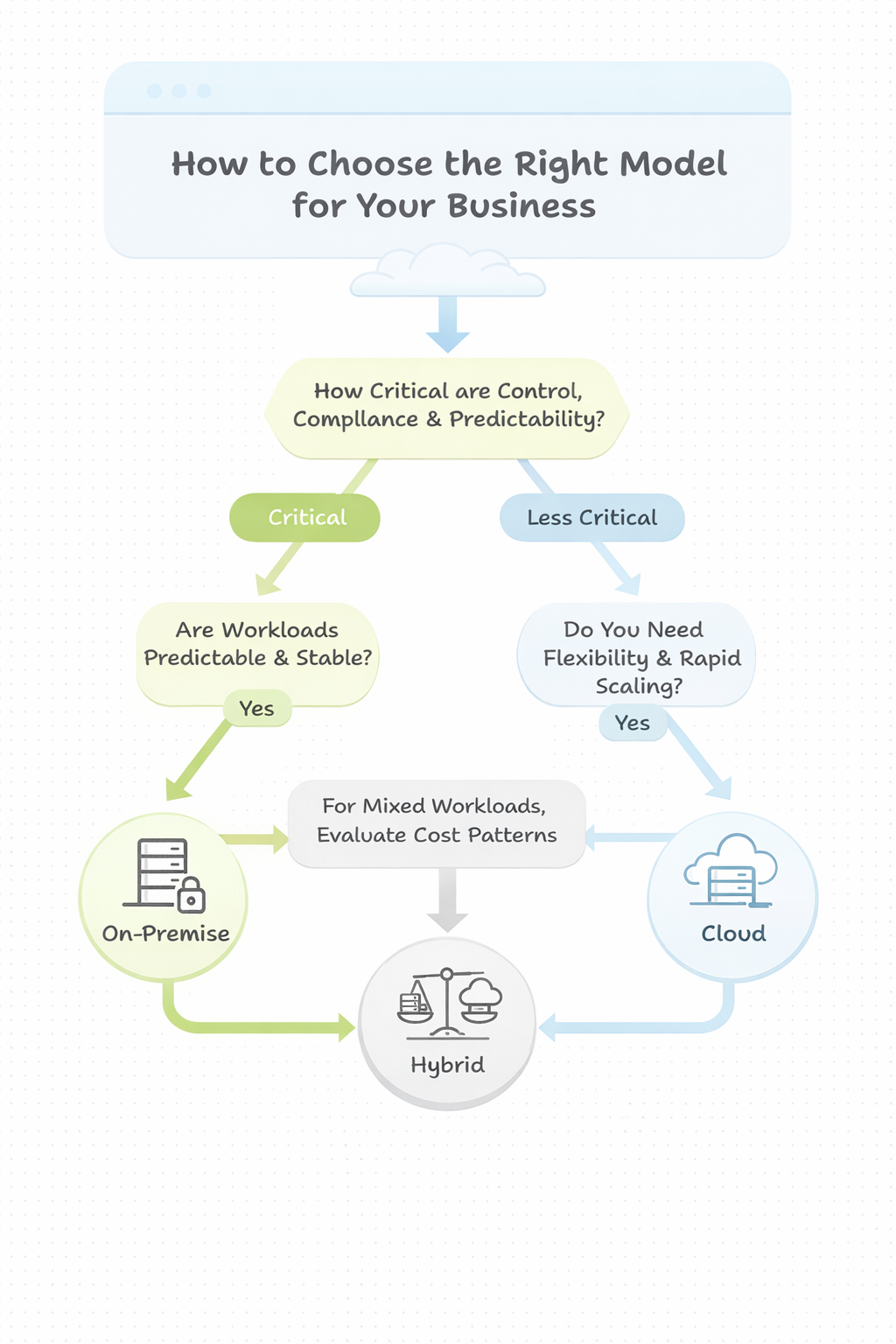
Control and compliance are another deciding factor. If you need strict data residency, low-latency access, or clear audit boundaries, on-premise or hybrid models may be safer. If speed, experimentation, and global reach are priorities, cloud platforms offer clear advantages.
Cost should be evaluated over time, not just upfront. Cloud reduces initial spend but can grow quickly without usage controls, while on-premise requires higher initial investment but offers more predictable costs for steady workloads. For many organizations, a hybrid approach ends up being the most practical balance.
Conclusion
There’s no single right answer when it comes to choosing between on-premise, cloud, or hybrid infrastructure. Each model solves different problems, and the best choice depends on how your workloads behave, what level of control you need, and how your business plans to grow.
Cloud works well for flexibility, speed, and scaling. On-premise remains valuable for predictable performance, compliance, and control. Hybrid approaches bring the two together, allowing organizations to modernize without unnecessary risk or disruption.
Rather than following trends, the most effective infrastructure decisions are made by placing each workload where it makes the most sense. When done thoughtfully, this approach gives teams the balance they need, control where it matters, and agility where it helps most.
Frequently Asked Questions (FAQs)
What is the main difference between on-premise and cloud infrastructure?
The main difference lies in ownership and responsibility. On-premise infrastructure is owned and managed entirely by the organization, while cloud infrastructure is hosted by a provider and accessed over the internet with shared responsibility.
Is cloud computing always cheaper than on-premise?
Not always. Cloud reduces upfront costs, but ongoing usage-based pricing can add up over time. For stable, long-running workloads, on-premise infrastructure can sometimes be more cost-effective in the long run.
Can businesses use both on-premise and cloud together?
Yes. Many organizations use a hybrid model, keeping certain workloads on-premise while running others in the cloud based on performance, compliance, or scalability needs.
Which option is more secure: on-premise or cloud?
Security depends more on how systems are managed than where they run. On-premise offers full control, while cloud providers secure the infrastructure but require customers to manage data access and configurations correctly.
When does on-premise infrastructure make more sense?
On-premise is often a better choice for workloads that require predictable performance, strict data residency, regulatory compliance, or deep system-level customization.
When is cloud computing the better option?
Cloud is usually better for workloads that need rapid scaling, faster deployment, global access, or frequent experimentation without large upfront investment.
How do organizations decide between on-premise, cloud, and hybrid?
Most organizations evaluate workload behavior, compliance requirements, cost over time, and operational capacity. In many cases, a hybrid approach provides the best balance between control and flexibility.